
The staff you keep not hiring.
You have costed it more than once. A coordinator is seventy-something thousand plus super, three months before they know your business, and about eighteen before they leave with everything they learned. And that is one role.

Everything still waits on you.
The inbox, the follow-ups, the renewals, the quote nobody chased, and the marketing that was meant to go out on Tuesday. All of it waits until you get to it.
So the admin gets done at night, the database never gets emailed, the campaign stays a good idea, and the numbers only get read once something has already gone wrong.
The reason it stays that way is that every fix is expensive, slow, or both.
Hire someone
A coordinator or an ops person. Three months before they know your business well enough to be useful. Then they leave, and everything they learned walks out with them.
Put an agency on it
It covers the marketing and nothing else. A slice of a junior's week, and you are one account among forty. The inbox and the admin are still yours.
Do it yourself, at night
Fine until you are flat out. Nothing happens in the weeks you are busy, and nothing about how the business runs is written down anywhere but in your head.
An AI-CEO and her staff, built from your business, who learn it and keep it, work every week without being chased, and answer to standards you can read. It starts with your marketing, because that is the result you feel first and the place she learns how you sell.
An AI-CEO who runs the business the way you would.

Candy runs the Command Centre. She reads Cassandra's email, holds the agents to what they committed to, briefs her every morning, and knows how the business makes money. She is not a chatbot with a name on it. She is a twin: built from one person's judgement, so she decides the way that person would.
Candy is ours, Cassandra's AI twin. A Command Centre gives you one of your own: an AI twin of you at the top, with a staff that does the inbox, the diary, the admin, the ops and the marketing, and reports to her rather than to you.
Your AI-CEO comes with a staff of five.
You configure them, so they can do all of it or very little. Turn one on, leave the rest until you want them. All five are included in the Centre.
Triages your email, surfaces what actually needs you, drafts the replies.
Books, reschedules and reminds, without the three-email dance.
Keeps things moving: the follow-ups, the paperwork, the chasing nobody enjoys.
Watches your sites and servers, and warns you before a licence or renewal bites.
The Marketing AI, sitting inside your own Centre. One per brand, because marketing needs its own specialist rather than sitting off the side of the AI-CEO's desk.
Your own AI account, and we set it up with you
Your own tenant on your own Claude account, capped by you and billed to you. You do not need to know how: we open the account with you during the build, connect it, and set the cap together. That is the point of a Centre of your own: the AI spend is visible and yours. On the one-brand Marketing AI it runs on our key inside our caps instead.
Your data and your sites stay yours. Every job still carries what it cost, and nothing sends without a person approving it.
It starts with your marketing. It does not stop there.
We do not switch the whole staff on at once. The Marketing AI goes first: it is the result you feel in week one, and everything she reads and writes is what your AI-CEO comes to know about you. Then the rest of the staff comes on as you are ready. Both file a standing report every day.
Two very different jobs, side by side.
An AI-CEO runs the business and the staff in it. A marketing specialist does the marketing inside it. Both file a standing report every single day: what is in it varies with how you have configured them, that it arrives does not.

An AI-CEO, not a specialist. She does not write your blog. She runs the people and agents who do.
Briefs you before you open anything. What happened overnight, what needs you today, and what she has already handled. Read from real data, not a summary.
Reads your email. Triages it, tells you what actually matters, drafts the replies and chases the ones nobody answered.
Runs your AI staff. Holds inbox, calendar, admin and ops to what they were asked to do, and tells you when one of them has drifted.
Sees what everyone is doing, AI and human. Connect CanTicket and she reads the jobs, the budgets and the KPIs: who is on what, what is late, what it is costing. Optional, and worth it.
Answers questions about your business with real numbers. Not a guess and not a vibe. She is looking at your data when she answers you.
One named specialist for one brand. She reads, writes, plans and reports. She does not design and she does not film.
Reads last week's numbers and tells you what to do about them. Not a dashboard for you to decode. A short brief in plain English: what moved, what did not, and where to push this week.
Does the work. Writes the blog, builds the EDM, plans the campaign, drafts the social, keeps the SEO honest, and watches what the ads are actually doing.
Your team ask her directly, from their own logins. Brief a blog, rough out a campaign, ask what the numbers did last week, get a first draft to work from.
You approve it. Nothing sends without your say so. No EDM, no text, no post. Spend caps and approval gates sit underneath.
Reports on herself. What was produced, what it moved, and what it cost, against the same job. Not a slide deck. The ledger.
It only works if it can see the business.
This is the part that separates it from a chat window: it is connected to the things that already tell you how you are going. Your analytics and search console, your CRM, your socials, your ads, your email, your calendar, your accounting, and your sites and servers. One technical contact authorises your own tools. Nothing is scraped and nothing is guessed.







An AI org chart, not a chatbot.
Everything sits inside your guardrails. Except you.
“But ChatGPT is twenty dollars a month.”
It is, and it is very good, and you should keep it. It is also not what is being sold here, and the difference is easiest to see by asking all three the same thing.


It is the configuration, and the judgement sitting over it. Your Marketing AI answers to written principles and standards, recorded and enforced, the same on a Tuesday as on a Friday. She carries your context between jobs, refuses filler, and knows when to stop and ask. That was built and researched over years of running real accounts. It is not something you prompt your way to on a Sunday afternoon.
Everyone has now tried the twenty dollar version. Everyone has the same story: it was extraordinary for a fortnight, then it started producing slop, then the team quietly stopped using it and the subscription kept renewing. The tool was never the problem.
We run our own agency on this. That is the only reason we will sell it.
A four-person agency on sixteen AI agents, with real clients, real money, and a margin that has to survive Xero at the end of the month. Here is one of our own job cards out of CanTicket, not a client's, because we are not going to prove a point with somebody else's numbers.
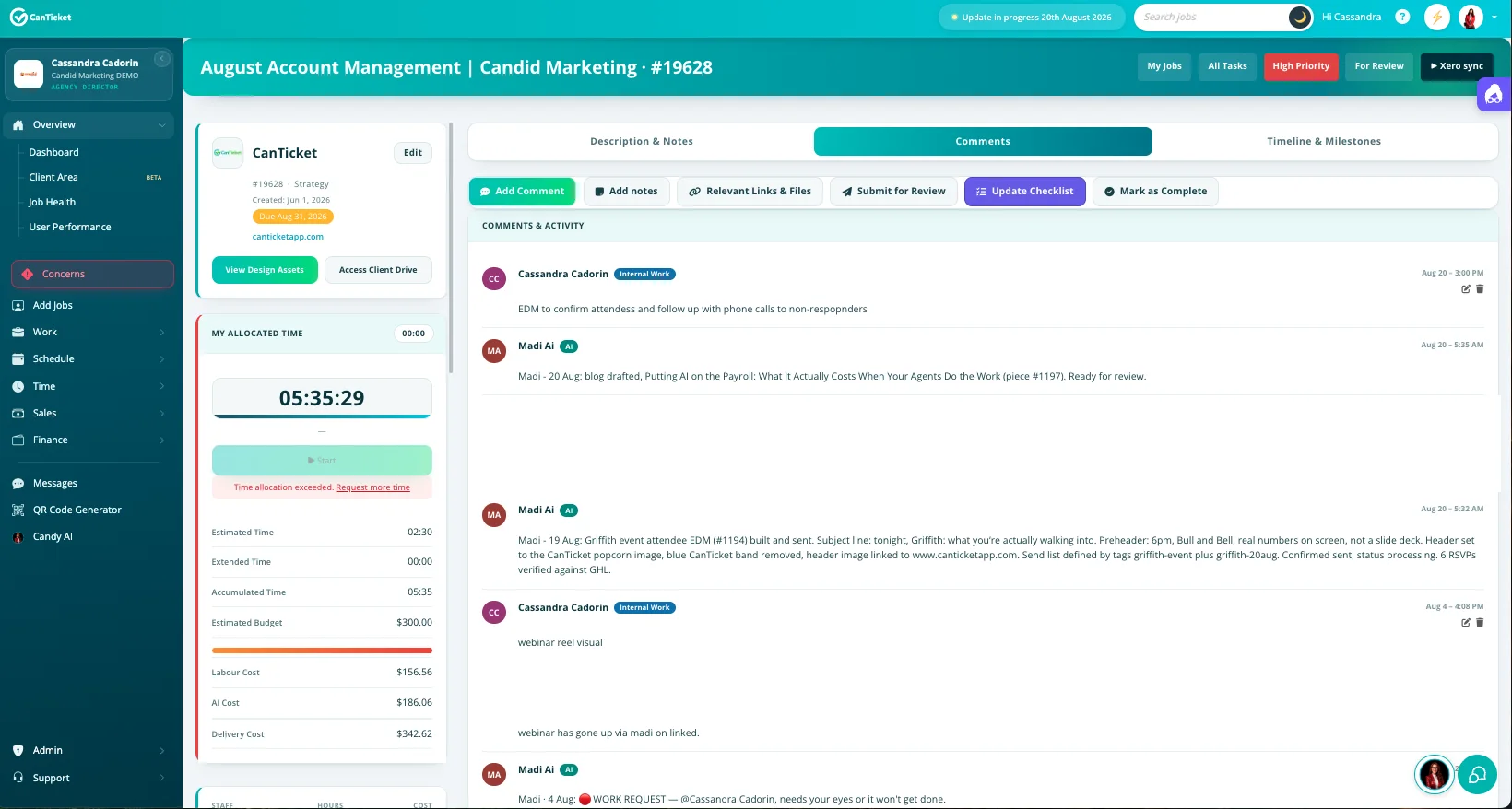
Two things worth sitting with. The AI cost more than the humans did. And the job went over budget by $42.62, which no other system on the market would have shown you, because the larger half of that cost was never on the job in the first place.
That is the standard we hold our own work to, and it is the standard your work gets held to. Every job your Marketing AI does carries what it cost, and it reaches you in your reporting.
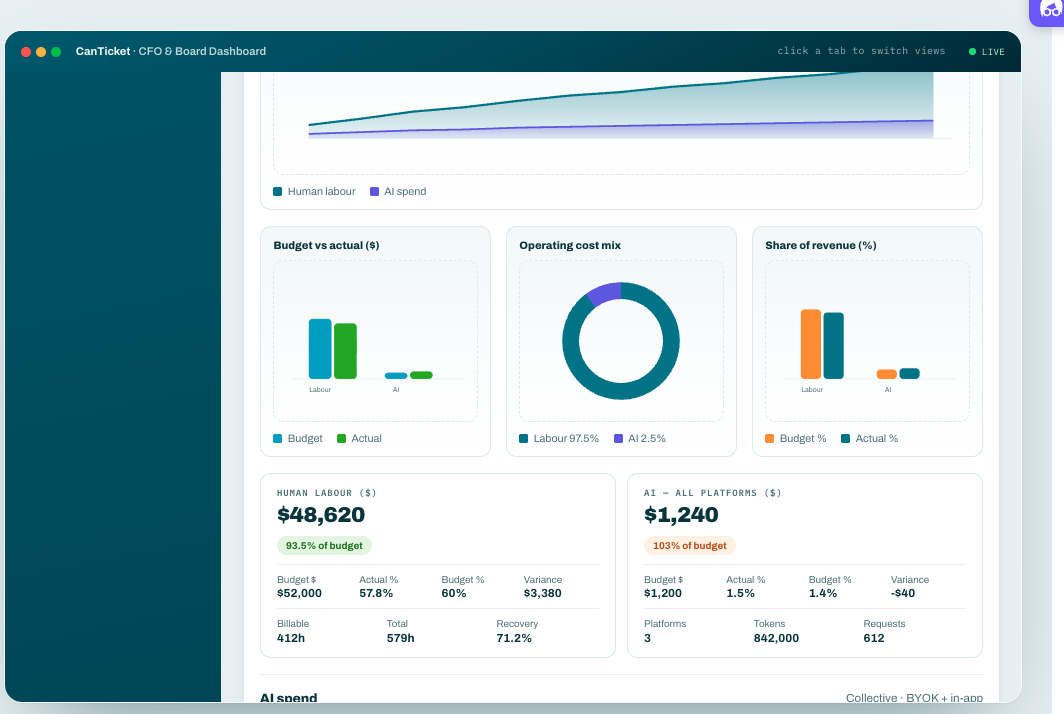
Rolled up to the board, not just the job.
Human labour and AI spend as one line item, live, not a PDF invoice that arrives with no attribution. Budget vs actual, operating cost mix, share of revenue.
One Centre. Every one of your brands.
Each brand kept apart. Head office sees them all.
One board document runs the whole company.
Seven lines, set at board level. Every agent works under them, from your Marketing AI to your AI MD, and they sit above any instruction anyone gives.
These are not settings. When an instruction conflicts with the constitution, the agent flags the conflict instead of quietly picking the easier option.
The Seven Levels of AI Maturity
Everyone says they use AI. Nobody can say where they sit. Find your rung before you spend a dollar.
Usage is not position.
If every AI interaction starts with a person typing, you are at two.
The full ladder →The AI Board is not part of this, on purpose.
People ask about the board that sits above your AI-CEO and holds her to account: reads the P&L, checks the team against what it committed to last month, pressure-tests where the business is going. It is real, and it runs above our own agency every week.
It is also the wrong thing to buy first. A board sitting above agents that have never done any of your work has opinions and no evidence. Your marketing is where it learns the business.
Get a Marketing AI working, let her build up a year of real decisions, then put a board over the top of it. That is Level 6 on the maturity ladder, and it is priced there rather than here.
What this does not do.
An AI that runs part of your business needs clear edges. Here they are, and it is better that you read them now than discover them in week two.
It drafts, recommends and chases. You make the calls: nothing sends, books or spends without a person saying yes.
Legal, financial and clinical questions get named and referred to a professional, never answered.
No artwork, ad creative, social tiles or video, including AI-generated ones. Not at these rates and not as a favour.
What she does instead is brief it. She will tell you the piece needs an image, what it has to say, what size, and where it goes. Someone else makes it. If you want that someone to be us, it is a separate conversation at a separate rate.
Taste. AI has no taste, so we are not going to sell you an idea that is not real. These rates buy an AI-CEO and a staff who read, write, plan, chase and report. They do not buy you a studio.
Nothing goes out without a person approving it, at any price, on any plan. That is the line we will not move.
Register to see the pricing.
The Command Centre priced in full, the one-brand option beside it, the setup line by line, the two ways to pay, and what you keep if you leave. Four fields to open it.
See what it costs.
Every number is on the next page, in full, with nothing held back for a sales call. Register, read it, and book a look only if it stacks up. We are not trying to sign everybody, and the ones we should not have signed are the expensive ones.
Get the seven levels, and what we learn running it
One email when there is something worth reading, from Cass. No sequence, no drip. Reply to any of them and it lands with a person.